







Normally, I write my blogs about the sport itself: about systems, choices, observations, and experiences in the loft. They are rarely personal or focused on one individual. The pigeon sport is broad enough, and most of the time it is about the game itself.
But this time, I am consciously making an exception.
The original intention was to write about the Olympiad taking place this weekend in Dortmund. About performances, expectations, and what is currently happening in the sport. But… this moment calls for something else. Because of the passing of my uncle Antoon, I will not be there. I chose to stay close to the family, to support his son Raymond where I can, and above all: to pause and reflect.
Because some people deserve more than a brief mention.
Some fanciers deserve a story.
That is why I am taking the time to write this blog. Not as an analysis, not as a lesson, but as a tribute. To a man who had pigeons his entire life, lived with his pigeons, and cared for them until his very last days.
To Uncle Antoon.
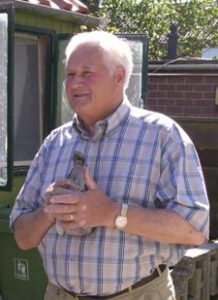
Some fanciers compete big because they think big. Others compete big because they love deeply. Uncle Antoon Schalkwijk undoubtedly belonged to the latter category.
Those who did not know him would hardly believe it. A miniature loft, almost stamp-sized: two sections only, one for the widowers, one for the young birds. In between the young bird section, a single nest pair of old pigeons, and above it all a small attic with no more than four breeding pairs. That was it. No palace. No luxury. No room to hide mistakes. And yet, he stood his ground among the big names. Not once. Not by chance. But consistently.
Great performances on a small scale
What Antoon showed was something you cannot buy: pure craftsmanship.
With that small loft, he first competed together with his son Raymond. Later, Raymond went his own way, but Antoon remained… exactly as he had always been: stubborn, sharp, proud, and completely one with his pigeons.
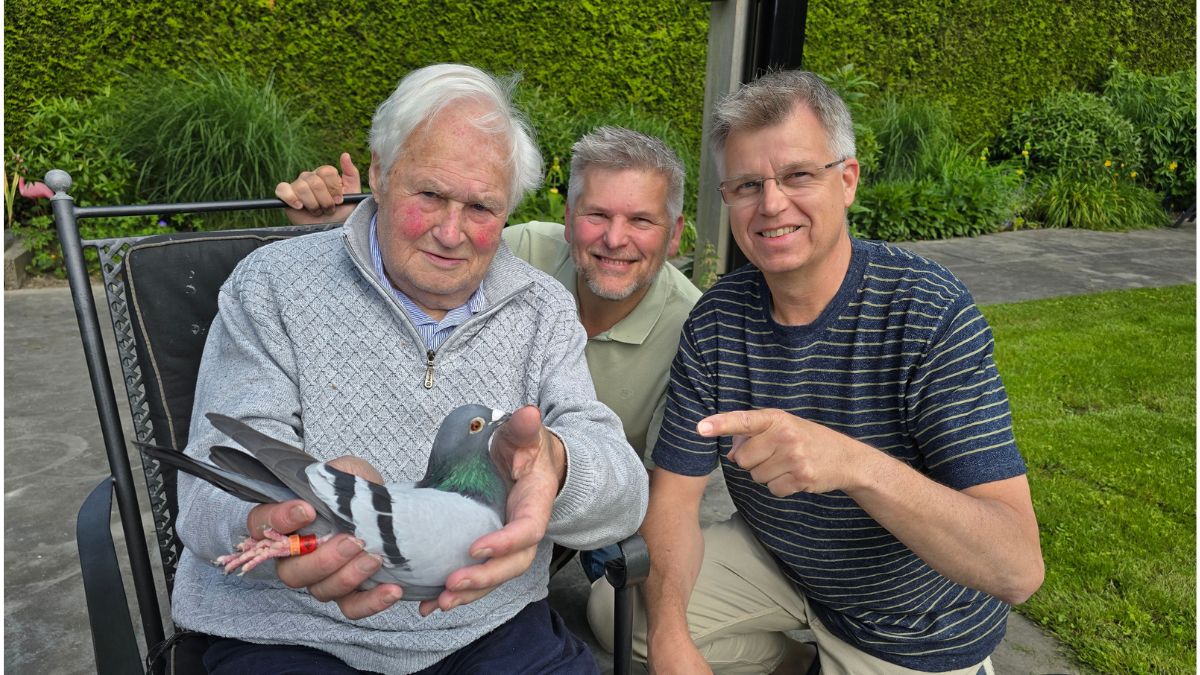
His victory with “De 18-Karaat” on National St. Vincent in Sector 3 (Departments 7, 8 & 9), over a distance of 1,046 kilometers at a speed of 908 meters per minute, was no stunt. It was the logical result of years of observing, feeling, selecting, and above all: understanding what a pigeon truly needs.
His pigeons did not just fly home. They flew to him. I have seen it myself: arriving pigeons that did not first look for their partner, but searched for their fancier. As if they wanted to say: “I’m back, Antoon.”
And that, that cannot be trained. That is built only through love.
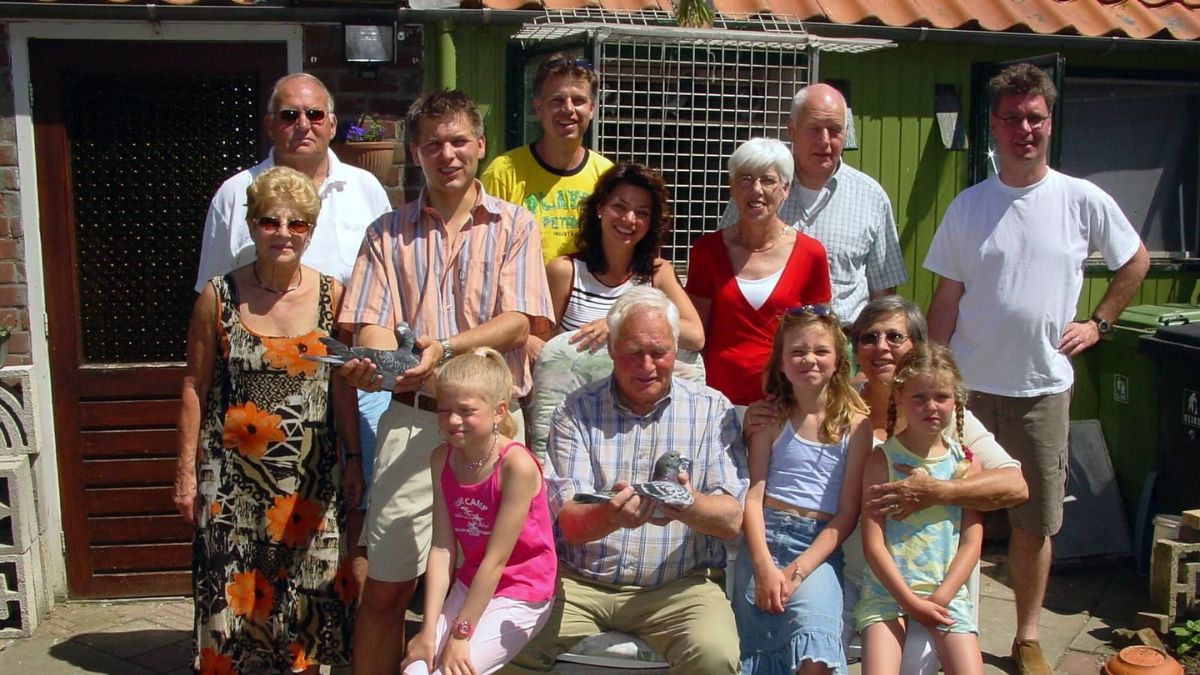
Fam. Schalkwijk after winning 1st National St. Vincent
A lifetime with pigeons
Antoon had pigeons his entire life. Until his final days, as long as he was able, he was still active in the loft himself. Feeding. Watching. Talking. Feeling and judging. I have never known his pigeons to be just a hobby. They were part of who he was.
He was not only a great long-distance fancier, but also a highly respected judge. His pigeons could perform on the toughest long-distance races and shine at exhibitions. First prizes in competition. Best in Show at exhibitions. Even at an advanced age.
What we can learn from him
Uncle Antoon proved something that still holds true today:
- You do not need a big loft to compete big
- Pigeons perform better when they fly for someone, not for a system
- Performance comes first. Being good and beautiful is rare, but possible
- Love for the pigeon is not a weakness, but a strength
He reached the age of 93. But his way of thinking is timeless.
For me personally, he is an example of pigeon sport at its very best: starting small, thinking big, and always staying close to your pigeons.
Uncle Antoon, thank you for everything you showed us, without ever needing to make it big.
🕊️ Rest in peace Dear Uncle Antoon, good flight
Until the next blog,
Gerard Schalkwijk
Schalkwijk Speaks