







While the spring sun should be welcoming the first training flights, a dark shadow looms over the lofts of Western Europe. Pigeon racing is currently caught in a sanitary stranglehold. From the Gelderse Vallei to the West Flemish polders, uncertainty prevails. The big question on every fancier’s mind: are we fighting a virus, or an inflexible system that still classifies the racing pigeon as a laying hen?
The Ede-Shock: Paralysis in the Logistical Heart
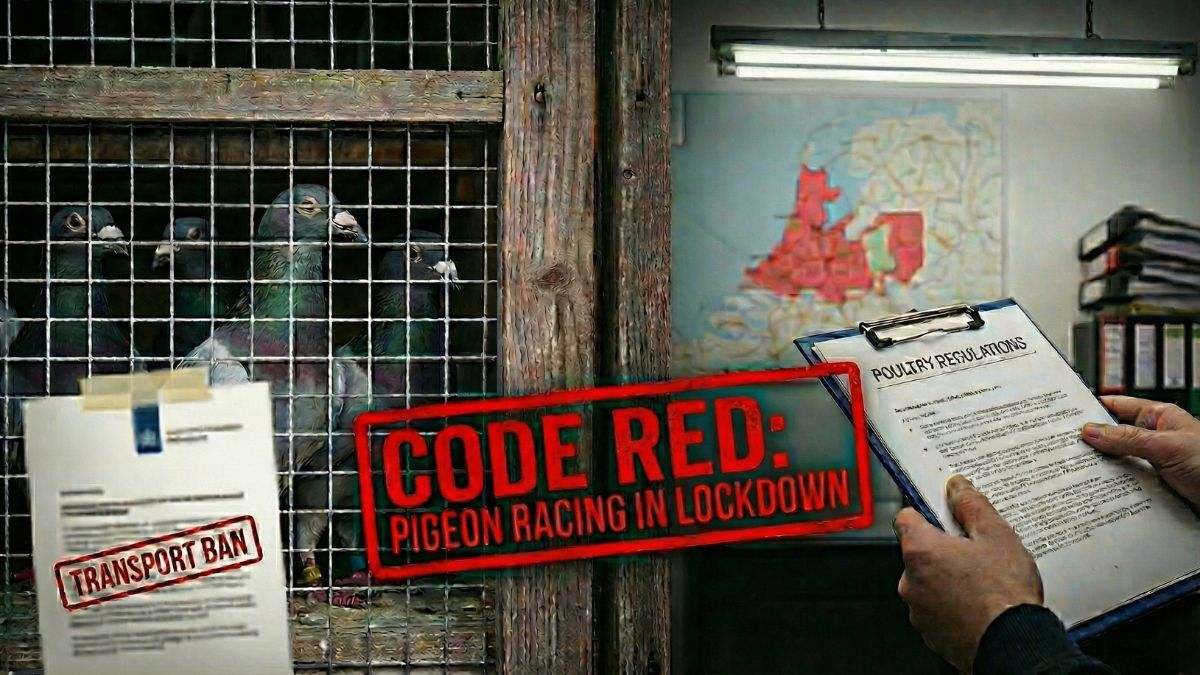
On February 24, 2026, the Gelderse Vallei turned into a sporting desert. The outbreak at a poultry farm in Ede is no mere incident; it is a strategic blow. With 122 poultry farms in the 10 kilometer zone, the impact is massive. However, the real pain lies in the dense population of pigeon fanciers in Ede, Lunteren, and Barneveld.
The transport ban is absolute. For thousands of pigeons ready for their first training flights, the trap remains closed. It is especially bitter due to the overlap with the Kesteren outbreak from January. Some fanciers have been in total isolation for over a month, a compounding effect that tests even the strongest motivation.
West Flanders: A Fragile Peace
In Belgium, the skies seem to be clearing, yet appearances are deceiving. Although the restricted zones in the Westhoek region (Veurne, Alveringem, Diksmuide) were lifted around February 19, the joy is short lived. Virus pressure from wild birds remains extremely high and is expected to persist until mid April according to the FAVV.
The recent infection at a hobbyist’s loft in Meulebeke on February 12 reminds us that freedom in West Flanders is currently a fragile truce. One wrong move from a passing goose and the season could end before it even begins.
Legal Hostage-Taking: Why the Pigeon is Still a “Chicken”
The greatest source of frustration is the persistent refusal of governments to grant the racing pigeon its own status. In 2026, both the NVWA and the FAVV still use the poultry label as soon as avian flu appears.
This is a deliberate economic choice. The multi billion export industry of eggs and meat is protected, while pigeon racing is treated as acceptable collateral damage. The lobbying efforts of the KBDB and NPO to categorize pigeons as sport animals with a low risk profile have yet to produce a legal breakthrough. Hundreds of fanciers are penalized for the health situation of a commercial farm miles away.
Impact and Psychological Attrition
The damage is not just emotional. Commercial breeding lofts in the Gelderse Vallei are currently unable to deliver their young pigeons to international buyers. Worse still is the attrition of members.
Conversations within local clubs show that uncertainty is leading to a record number of resignations. After three years of consecutive interruptions, older fanciers in particular are losing heart. The sport is aging faster than it can renew itself.
The Digital Path Forward
Tomorrow, Friday February 27, the KBDB will convene. The expectation is that the crisis will be used to accelerate the implementation of the FCI Cloud and the Breeder ID. The argument: better traceability during outbreaks. Is this the digital lifeline the sport needs to decouple itself from the poultry sector, or is it a technological barrier that pushes the last doubters over the edge?
Pigeon racing stands at a crossroads. The passion is unchanged, the quality of the birds is higher than ever, but the bureaucratic cage remains firmly locked. It is time the pigeon finally receives the status it deserves: an athlete of the skies, not a byproduct of the poultry industry.
Jan de Wijs
The Pigeon Boss