







Or, why do healthy pigeons lose their competitive edge during the season?
Many fanciers are familiar with this phenomenon: the pigeons look healthy on the outside, their training is going well, the feed is of high quality, and yet the hoped for results fail to materialize. The birds do not return home sick, but they are noticeably later than expected.
One factor that is often overlooked lies deep within the pigeon: gut health. To be more precise, subclinical clostridial infection in the gut can significantly reduce performance without causing classic symptoms of disease.
Clostridia: A Natural Resident with a Serious Risk
Clostridia are anaerobic, spore forming bacteria that occur naturally in the intestines of racing pigeons. In small quantities, they are part of the normal intestinal flora.
It becomes problematic when the microbiological balance is disturbed, for example by:
Stress during the racing season
Changes in the feed
Administration of antibiotics
Accompanying infections
In such situations, clostridia can multiply rapidly, form toxins, and irritate the intestinal mucosa, often without causing visible diarrhea or acute illness.
In these so called subclinical cases, the pigeons appear healthy but sometimes show a dull plumage, delayed regeneration, and poor form. Young birds, old birds after heavy flights, or those who have completed six to eight flights in a season are particularly vulnerable. Increasingly, we also see that teams are especially susceptible after medication. The result: the pigeon flies well below its potential.
Science and Practice: What We Know
Direct studies on the influence of subclinical Clostridia on the flight performance of racing pigeons are still lacking. However, numerous studies in the field of poultry science show that Clostridium perfringens can be found in other bird species even without severe symptoms, causing significant loss of performance.
Microbiome research also provides clear evidence: a stable intestinal microbiome is a vital prerequisite for health and performance.
These findings match the years of experience of specialized racing pigeon veterinarians: pigeons with an unclear weakness in form often show elevated clostridia levels, and their results improve significantly as soon as the intestines are specifically stabilized.
Why Strategic Gut Reorganization is the Key to Performance
The most important findings from science and practice are clear: a damaged or unstable intestinal microbiome does not recover on its own, and certainly not in the short term.
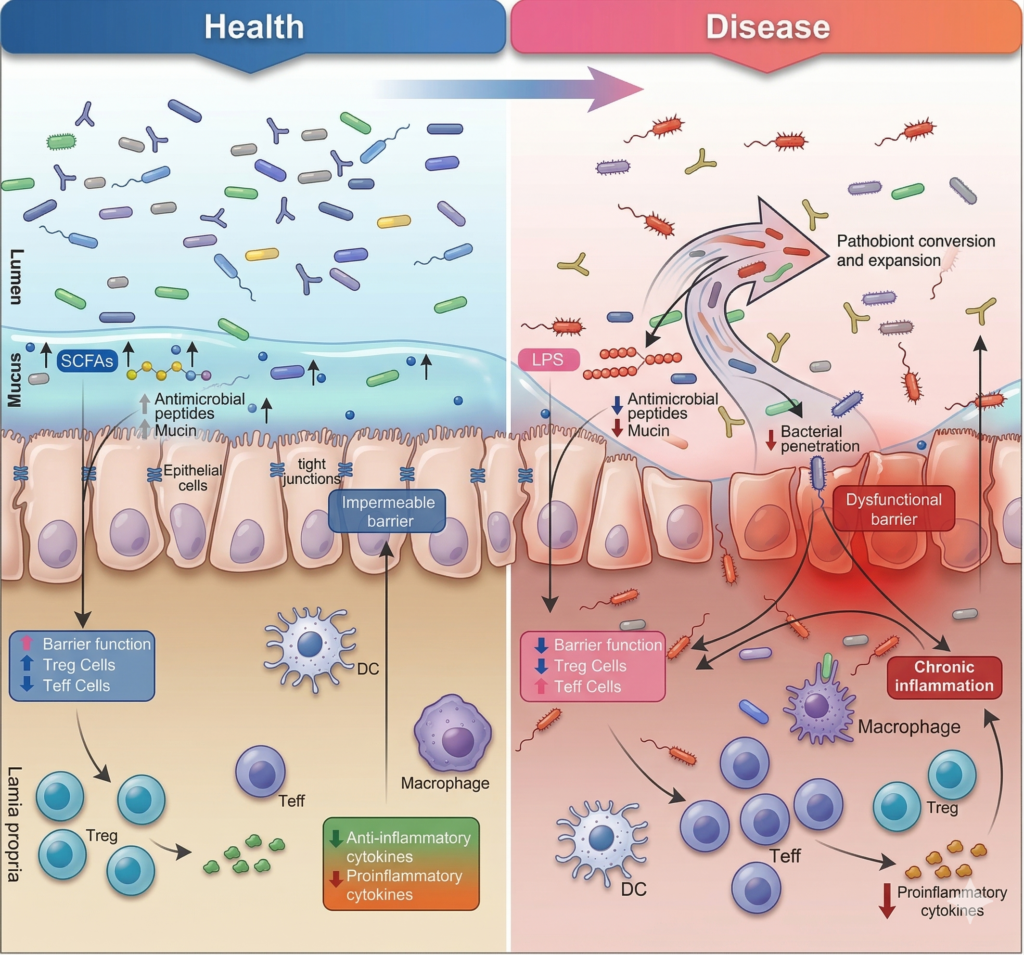
(Fig.: Schematic representation of the healthy and diseased microbiome.)
Subclinical infection with clostridia is not an acute problem, but rather a chronic process that builds up over weeks and months. This is exactly why it is not enough to use a product selectively or to try to “improve” it on short notice during the season. Performance is only achieved if the gut is stabilized in the long term.
A gut rehabilitation program introduced at an early stage and organized strategically is therefore the decisive lever. Ideally, this starts long enough before the competition season and continues consistently throughout the season.
SymBiotic: Why the Interaction of Different Probiotics Truly Works
An efficient microbiome is not a mono system, but a finely tuned ecosystem of different microorganisms with clearly divided tasks. This is exactly the decisive advantage of a true SymBiotic.
High quality SymBiotic products make conscious use of the interaction of different probiotics that complement and strengthen each other:
Why Starting Early and Long Term is the Decisive Factor
A stable microbiome needs time to build up. it reacts sensitively to stress, flights, weather, and changes in food. Therefore, it must be constantly maintained.
The earlier the gut rehabilitation begins, the more stable the performance remains during the season. Fanciers who only react once performance has already been lost are often fighting against an already chronically disturbed balance. The optimal effect of probiotic bacteria is only achieved with continuous daily intake.
Conclusion: Take Gut Health Seriously as a Performance Factor
The essence of all findings is this: Clostridia are often not the real problem, but rather a symptom of an unstable microbiome.
In practice, this means:
Regular fecal analyses help to recognize subclinical problems at an early stage.
Antibiotics should not be used prophylactically, but only in a targeted manner.
After stress, the gut needs active regeneration.
Only strategic, long term gut restoration with a true SymBiotic builds the microbiome sustainably, protects against subclinical performance loss, improves regeneration, endurance, and flight speed, and creates constant form throughout the entire competition season. In this way, the basis for clostridial overgrowth is removed right where performance is unnoticed and lost.
Final Word for Racing Pigeon Enthusiasts
Subclinical clostridia are among the most common but least recognized performance brakes in the sport of pigeon racing. If you want to achieve top results in the long run, you must manage the gut health of your pigeons as consistently as you do their training and feeding.
You want to optimize the gut health of your team and reach the full performance potential of your pigeons. Start now with a targeted gut cleansing:
Fecal analysis
Reduction of unnecessary burdens
Use of high quality Symbiotics for stabilization of the microbiome
Tip: We now recommend a daily Symbiotic gut treatment for two to three weeks at a time.
Alfred Berger