







Metabolic Optimisation and Cellular Adaptation in Racing Pigeons | Justification for the 2-Phase Recovery Protocol
 As co-founder and co-owner of DoCa-Pharma and Fly-Max, my passion lies in the physiology behind modern pigeon racing. At DoCa-Pharma, we strive to make complex scientific insights accessible and applicable to every fancier. With Fly-Max, we focus specifically on the development of innovative products and molecules that are currently lacking on the market.
This article forms the physiological basis of that vision.
1. Introduction: The physiological paradox of pigeon racing
During a flight, pigeons deliver an energetic performance that is unique in the animal kingdom. The fancier’s focus has traditionally been on ‘refuelling’ with energy. However, the limiting factor for successive performances is not only the available fuel, but also the cellular damage sustained and the speed at which the metabolism recovers and adapts.
Based on recent and established scientific insights, DoCa-Pharma has developed a protocol in which we divide recovery into two phases. The article below requires some reading but provides a solid foundation for easily understanding subsequent articles and contextualising the effects of various supplements within this principle.
2. The energy cycle and the development of damage.
To understand how our protocol works, we must first look at the energy metabolism of the racing pigeon:
The Primary Energy Source: Glycogen (sugars stored in the muscles)
The primary energy source during high-intensity activity, stored in the liver and muscles. However, this supply is limited and cannot simply be increased.
Studies show that a standard amount of sugars (glycogen) is stored in the muscles. Adding extra sugars without a clinical stress response that allows for the storage of more sugars is of no use.
Note also that we are referring to glycogen and not to glucose or other forms of sugar. The sugars we administer do always cause an increase in blood sugar levels but not necessarily in the muscles. In sprint races where the pigeon ‘sprints’ on sugars alone, this leads to acute acidification.
The Secondary Energy Source: Fat Burning
During longer flights, the pigeon switches to burning fats. The liver breaks down these fats (beta-oxidation), producing ketones.
Ketones/fats are a superior fuel. Whilst carbohydrates (sugars) provide only 4 kcal per gram, fats and ketones provide as much as 9 kcal per gram. They are therefore more than twice as energy-dense. Moreover, they consume less oxygen in the muscle cell engine. However, this mechanism also has a negative impact. We refer to this as oxidative stress.
3. Acute acidification / Oxidative stress
Acute acidification is a physiological state in which, during explosive exertion, the pigeon’s muscles produce waste products faster than the body can eliminate them, causing the pH level in the muscle cells and blood to drop critically. This mechanism is the speed pigeon’s main physiological enemy and proceeds in three successive stages:
1. Anaerobic metabolism (Flying without oxygen)
During a short sprint, a pigeon flies constantly at top speed. The breast muscles contract so rapidly and powerfully that the blood circulation cannot supply sufficient oxygen quickly enough. As a result, the muscle cells are forced to switch to anaerobic glucose combustion = the rapid depletion of primary sugars (glycogen) without the aid of oxygen.
2. The accumulation of hydrogen ions and lactate
This rapid, oxygen-free sugar combustion produces a biological by-product, pyruvate, which is immediately converted into lactate (lactic acid). At the same time, large quantities of hydrogen ions are released.The misconception: Lactate itself is not the culprit, on the contrary, it is an emergency fuel for the heart and brain. The real culprits are the free hydrogen ions, which cause the actual, acute chemical acidification. They rapidly lower the pH level in the muscle cell.
3. The physiological blockage
When the pH level in the pectoral muscle becomes too low (too acidic), this immediately blocks the biochemical functioning of the cell. We experience muscle cramps and fatigue. The enzymes that normally release energy (ATP) from sugars cease to function in an acidic environment. We experience reduced contraction and the interaction between the muscle proteins (actin and myosin) is blocked, meaning that the pigeon is physiologically unable to beat its wings powerfully. The bird ‘stalls’ in the air.
Oxidative stress is a physiological condition characterised by a structural imbalance between the production of reactive oxygen species (free radicals) and the body’s ability to neutralise them using antioxidants. When the production of these free radicals exceeds what the cell’s natural defence systems can handle, biological damage occurs. These aggressive particles attack vital cell structures, such as the cell membranes (lipid peroxidation), proteins and the DNA within the muscle cells. In pigeon racing, this damage leads directly to cell death and microtrauma in the pectoral muscles.
These free radicals are released at various points during the flight:
The metabolic switch (the tipping point):
When the sugars run out and the cell has to switch abruptly to fat burning, the engine stutters momentarily. This causes an initial peak in oxidative stress.
Incomplete combustion:
To burn ketones and fats ‘cleanly’, the cellular engine always needs a small amount of residual sugars (the biochemical law: ‘fats burn in the fire of carbohydrates’).
However, after hours of flying, the sugars are truly 100% depleted. As a result, fat burning becomes incomplete and impure. The physiological engine literally starts to ‘smoke’. This process causes an explosion of free radicals. These particles attack healthy cells and cause microtraumas (microscopically small tears) in the muscle fibres and acute inflammatory reactions (inflammation).
4. The revolutionary 2-phase recovery protocol
-

Fly Max | Keto Fly
€ 40,00 – € 65,00Price range: € 40,00 through € 65,00Select options This product has multiple variants. The options may be chosen on the product page
-
Sale!
Pigeon Boss Champions Pack
€ 179,75Original price was: € 179,75.€ 161,75Current price is: € 161,75.

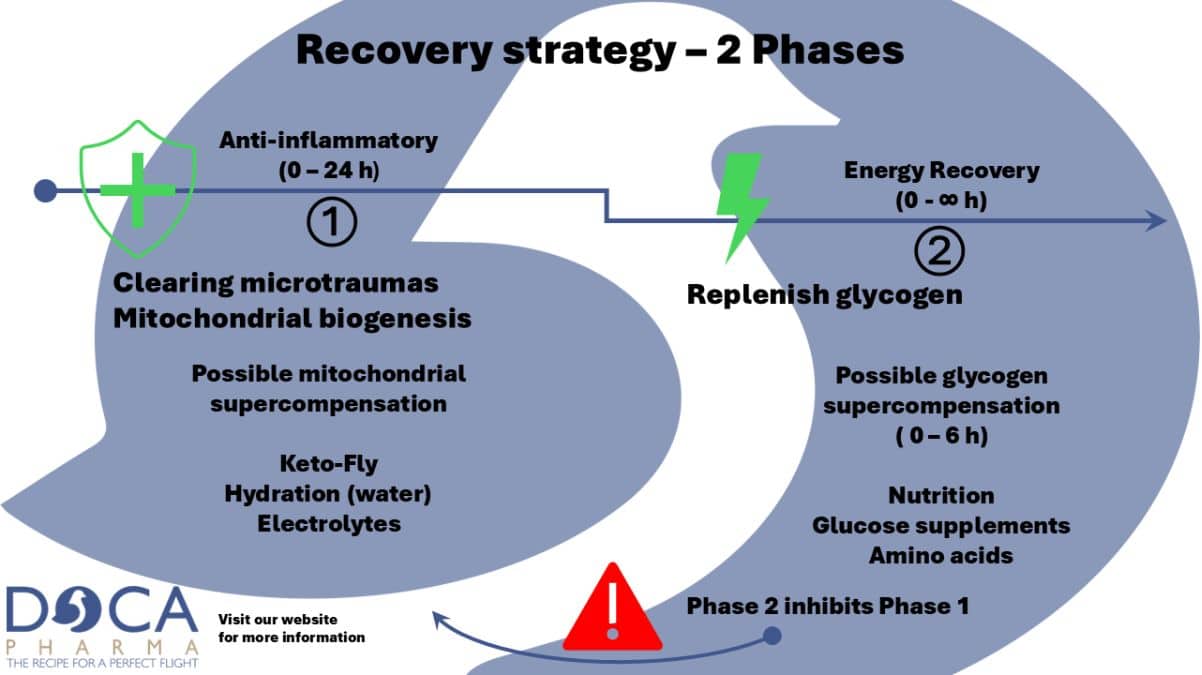
Scientific literature (including Tidball, 2005 and Ivy et al., 1988) suggests that recovery is not a linear process, but should be divided into two or more phases. Since the first phases largely overlap and share the same ultimate goals, we group them together as Phase 1.
The figure above illustrates the two critical phases that can influence one another:
Phase 1: The Priority Phase (Anti-inflammatory: 0 to 24 hours)
Immediately after exercise, the body is programmed to clear away microtraumas and create new energy powerhouses (mitochondrial biogenesis).
In short-distance racing pigeons, this is the moment when we will tackle acute acidification with the help of electrolytes.
This is also the only window in which mitochondrial supercompensation, the structural strengthening of the engine, can take place optimally.
We set a timeframe of 0 to 24 hours for this, but be aware that the harder the race, the longer this recovery will take. The first few hours are crucial, however, and administering the right supplements will promote this.
The observant reader will also note that, in the first phase, there is no specific mention of antioxidants, which would be the most obvious supplement against oxidative stress. The reason for this is simple;
Anyone walking into the average specialist pigeon shop today immediately encounters a problem. Virtually all recovery drinks or ‘recovery powders’ are all-in-one formulas. They combine excellent antioxidants with carbohydrates or heavy amino acids.
From a physiological point of view, this is a death sentence for Phase 1; the sugars force the intestinal wall to digest and immediately shut down cellular cleansing.
For Phase 1 to work properly, you must look specifically on the label for an isolated, liquid antioxidant or vitamin complex (for example, based on pure Vitamin C, Vitamin E or liquid plant phenols).
The golden rule: the product must contain absolutely no, or as little as possible, added sugars (glucose, maltodextrin), fats or intact proteins. Only then will the restorative substances pass through the intestinal wall via passive absorption, without activating the digestive system.
The Critical Warning (The red warning triangle)
A common mistake is starting Phase 2 too early. As the diagram shows, Phase 2 inhibits Phase 1. As soon as large amounts of food or sugars are consumed, the body switches to digestion. This immediately puts the important recovery processes of Phase 1 on the back burner.
Phase 2: The Energy Recovery Phase
Although replenishing sugar stores is necessary, we can make use of an interesting physiological effect. There is a specific window of 0 to 6 hours after exercise during which the muscles’ uptake capacity is at its highest (glycogen supercompensation). This ensures that when carbohydrates are administered in Phase 2, the efficiency of sugar uptake is maximised, leading to up to 50% higher glycogen supercompensation in the muscles than with traditional methods.
When administering amino acids in this phase, it is preferable to specifically choose BCAAs (particularly leucine). Leucine activates the mTOR biochemical pathway, which is the direct ‘switch’ for muscle protein synthesis and structural repair, without placing an unnecessary strain on the digestive system.
I would also like to refer here to a point mentioned above regarding the difference between glycogen and sugars. In this phase, it is therefore possible to replenish those muscle sugars (glycogen) beyond their standard levels. However, we are still conducting further research into how long this effect persists in the muscles and whether we can maintain this elevated level until the next flight.
In my opinion, depending on how long the elevated levels remain in the muscles, this mechanism is therefore only of interest for sprint races where weekly races are held over distances that are highly dependent on available glycogen stores.
The role of high-quality feed in this phase
Naturally, this energy recovery stands or falls on the right feed. How you adjust your grain mixes in Phase 2 depends heavily on the type of races you enter and the energy expended. Fortunately, there are already plenty of excellent and professional feed manufacturers on the market today who can perfectly underpin this nutritional aspect and specify exactly what your pigeons need in terms of grains and basic mixes. Our focus is therefore not on replacing this established expertise, but on providing specific molecular support for it.
5. Conclusion and outlook
With this two-phase recovery protocol, DoCa-Pharma moves away from the traditional recovery method. By physiologically separating the recovery phases, you prevent the digestive system from blocking cellular cleansing and deacidification. The result is more efficient recovery, the effective reduction of oxidative stress and superior energy storage.
In the following articles, we will translate the theoretical basis into practice and discuss the various recovery products and specific molecules, such as ketones, L-carnitine, lecithin and the like, in detail. We will examine how these substances have a direct, regulatory influence on the physiological processes described above.
It is important to note that we will deliberately not mention any specific brand names in these articles.
Our focus is purely on the scientific and biological effects of the molecules themselves. By leaving brands out of the equation, we maintain objectivity and help you, as an enthusiast, to look critically at labels yourself, rather than blindly relying on marketing promises.
Supplements alone are not the decisive factor.
Ultimate success is always a combination of factors, with diet, training duration and training volume forming the absolute foundation. In addition, external factors (such as unexpected weather conditions, wind and the difficulty of the flight) play a crucial role that we can never perfectly predict in advance. In our sport, there are always exceptions to the rule. The principles discussed should therefore serve as a biological guideline, which every fancier must adapt to the specific needs of their own colony.
Science is only valuable if it helps improve practice in your loft. That is why I would love to hear from you!
Do you have specific questions about this 2-phase recovery protocol?
Is there a specific molecule or a particular supplement (such as L-carnitine, electrolytes or amino acids) whose exact biological mechanism you would like to understand?
Send your questions and suggestions to the Pigeonboss editorial team or directly to me (info@doca-pharma.be). If your question is too specific or too short for a full article, that’s no problem. I’ll collect all the shorter practical questions and compile them once a month to answer in a separate, exclusive Q&A post on Pigeonboss. In this way, we’ll build a strong physiological foundation for the whole colony together!
Wishing you every success for the rest of the season!
Casper de Pryck
Founder Fly Max | Keto Fly