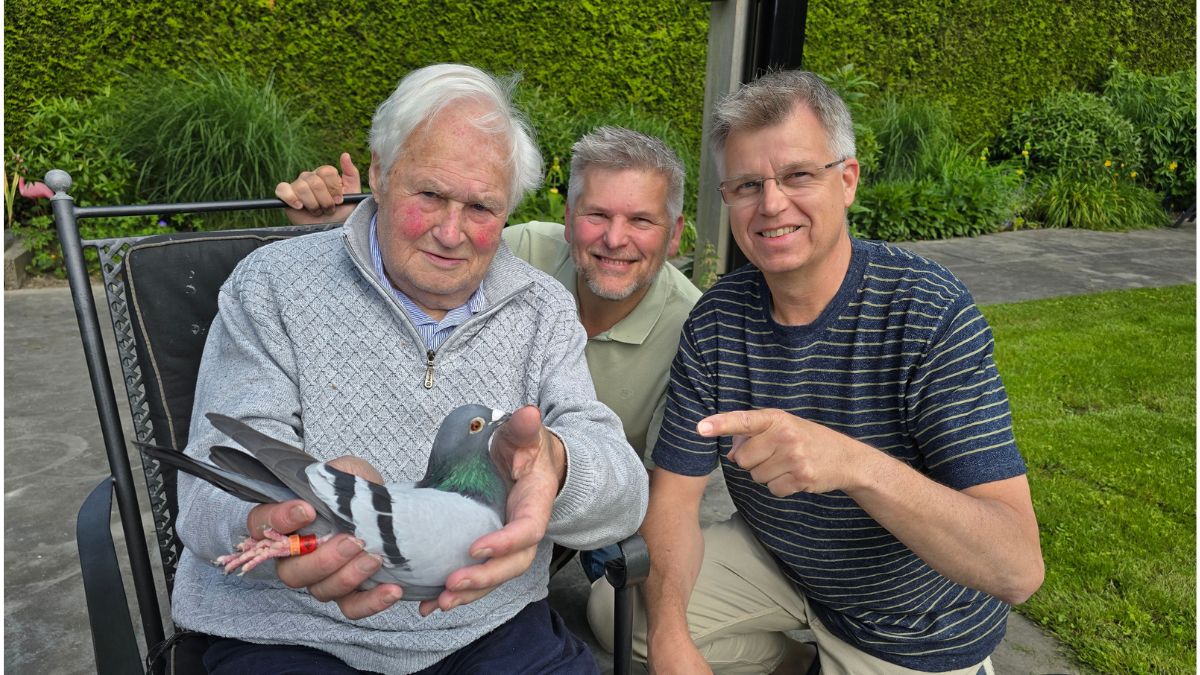










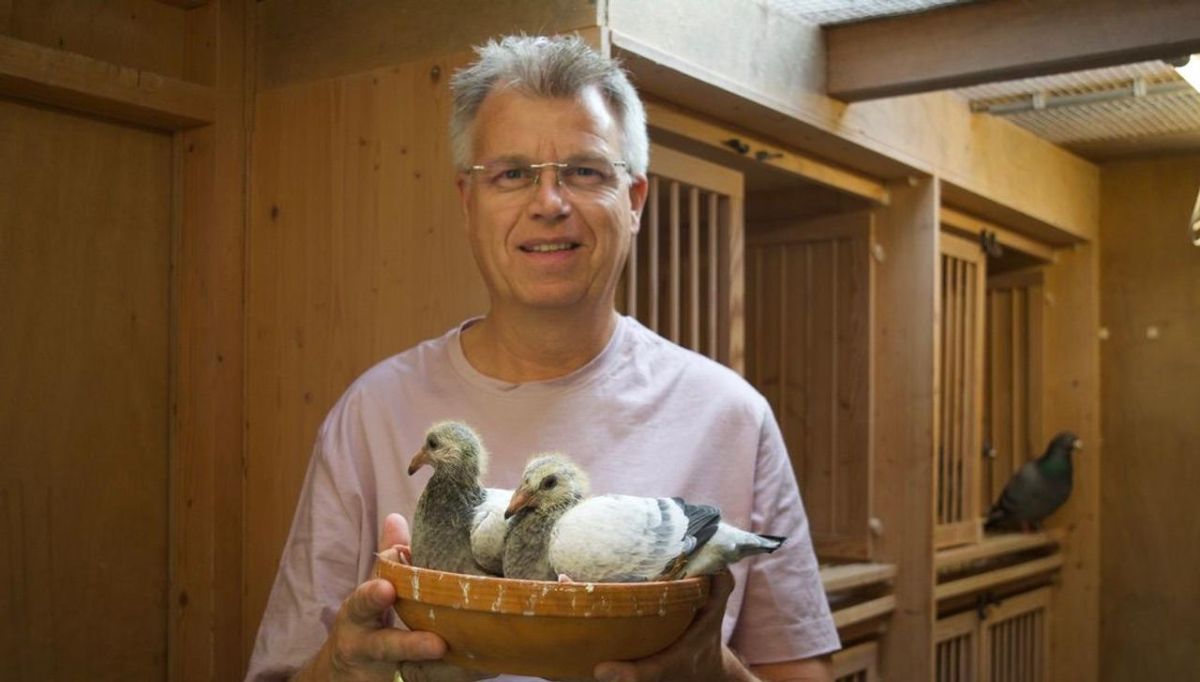
Before we get into this I like to tell you, some positive news. Over the past weeks, we have once again received some very nice messages.
Descendants of Schalkwijk Pigeons continue to show great performances, again and again, also in other lofts. And honestly, that remains one of the most beautiful things in the sport. Not only performing yourself, but especially seeing that your bloodlines also prove their value for other fanciers.|
For example Pigeons with Schalkwijk Pigeons blood: “Surprise” of Rik Ros from Lekkerkerk (The Netherlands) performed super again from Bergerac, winning 7th NPO Bergerac against 3.411 pigeons and 51st National Bergerac against 24.970 pigeons.
Earlier this year, the wonderful 4th National Barcelona, “Cleo”, by Geert de Coninck (Belgium).
We also received the beautiful news from Sven and Wim van Houten (The Netherlands), who won 3rd National Narbonne with a pigeon that also carries Schalkwijk Pigeons-blood. Those are messages that make you happy as a fancier.
For those who enjoy following these kinds of performances and backgrounds, feel free to take a look at our Facebook page Schalkwijk Pigeons. There we regularly share beautiful references, performances, and stories from fanciers where Schalkwijk Pigeons blood can be found, OLR information as well as other interesting insights from the pigeon sport.
But precisely in a period like this, when performances become visible, you also hear the other side of the sport. Fanciers who lose young pigeons. Sometimes during the first training tosses. Sometimes already from short distances. That hurts! Because a young pigeon represents months of work. Care, training, and everything that comes with it. You do not breed them just to lose them again of course. And perhaps even more importantly, there is expectation in them. The expectation that this particular young pigeon might show something later on. And then it does not come home.

DOMINATE THE SKIES WITH THE PIGEON BOSS SUPPLY PLAN
Get the proven schedule for peak racing condition, maximum endurance, and unbeatable performance in your loft. Digital and delivered straight to your inbox.
The easy answers.
When young pigeons disappear, you often hear the same explanations. It must have been a bird of prey or the weather, or there must have been some disturbance in the air. Or nowadays you sometimes also hear, it must be 4G or 5G. I do not believe that birds of prey are the real problem. Of course, bad weather can certainly trouble pigeons. And I understand that fanciers look for explanations when young pigeons simply stay away. But honestly that does not explain everything.
If it were only birds of prey or transmission masts, the losses would be much more predictable. You would see clear patterns. But often that is not the case.
Sometimes young pigeons disappear from experienced fanciers. Sometimes from a distance where you think this cannot possibly go wrong. Another reason can also be cross liberations, large groups of pigeons crossing each other on the way and young birds being pulled along with the wrong group.
Orientation has to grow.
Many people think that a racing pigeon is born with a perfect compass. It is not that simple. A young pigeon has to learn its surroundings. Those circles around the loft are not just happening for no reason. That is where orientation begins. They learn enviroments, fields, water, wind directions, and smells. Slowly, they build their own map. If that map is not complete yet and you move too quickly with training, things can go wrong. A young pigeon can leave powerfully and still fly completely in the wrong direction. To the eye, it may look strong. But flying strongly is not the same as flying correctly. And once it is on the wrong line, every kilometre becomes heavier.
Health is the silent factor.
Then there is another point, health.
Young pigeons can look good to the eye and still not be one hundred percent. That is the difficult part. Adeno, E. coli, Young Bird Disease, intestinal problems, respiratory issues, or reduced immunity can all be present quietly. Sometimes they still eat quite well. Sometimes they still train along just fine. But internally, they are not strong enough. And then only very little has to happen on the way. A little confusion, some headwind, a bit of stress, and suddenly the reserve is gone.
A pigeon that is fully healthy and strong can sometimes still correct a mistake. A pigeon that is already under pressure often cannot.
Stress makes Everything bigger.
We must also dare to look honestly at ourselves. Sometimes we want to go too fast. The youngsters have to go early. The distances have to increase. The team has to be ready. We look at the calendar, the racing programme, and what someone else is doing. But young pigeons know nothing about a calendar. They have to learn, become stronger, and build confidence. Basket stress, transport, unfamiliar release points, pressure in the loft, insufficient recovery, and increasing the training distance too quickly can together become a major problem. It is not one single thing that breaks a young pigeon. It is often the total sum.
My Advice.
I do not believe young pigeons just disappear for no reason. There is almost always a reason. Only that reason is often not found at the moment of liberation. It usually lies in the days before. That is why, with young pigeons, I always look at 4 things:
- Orientation: Have they flown enough around the loft before they are really taken away?
- Health: Are they truly healthy and strong, or do they only look that way?
- Recovery: Do they return fresh after training, or can you see they have gone too deep?
- Pace: Are you moving at the pace of the pigeon, or at the pace of your own impatience?
Because that is often where things go wrong. Not because the fancier is not trying hard enough. On the contrary. Often because he wants it too much.
Finally
Young pigeons usually do not disappear because of one single cause. It is often a combination of incomplete orientation, hidden health problems, stress, and building them up too quickly. Having patience with your young pigeons is not weakness. Patience is respect for the pigeon. Because a young pigeon must not only be able to perform. It must also understand where it has to navigate to. And it must be healthy enough to get there. Whoever forgets that sometimes asks more of his young pigeons than he realises.
Until the next blog,
Gerard Schalkwijk
Schalkwijk Speaks