






The Molecular Revolution with Keto-Fly
In our previous article, we introduced the physiological principle behind the 2-phase recovery protocol. One of the most revolutionary elements within this protocol is exogenous ketones.
If you analyze the market, you will see that ketones are available in two forms: ketone salts and liquid precursors/ketones. Both forms have their specific biological value, provided they are deployed at the right time. Yet, as a fancier, it is essential to understand the physiological difference between what is currently scientifically available.
The physiological distinction: Ketone salts versus liquid precursors
Ketone salts (Powders): These products are chemically bound to minerals such as sodium, potassium, or calcium to make a stable powder. They have a proven biological effect, but due to this salt linkage, they are less suitable for the acute Phase 1 directly upon arrival. The extra mineral load requires too much digestive work from an exhausted intestinal wall at that specific moment.
Liquid precursors/ketones: Currently, a patented liquid variant is available on the market (Keto-Fly) that is specifically formulated for the physiology of racing pigeons. This active liquid is completely free of salt linkages. Because it is liquid, it passes through the intestinal wall directly via passive absorption without activating the digestive engine. This makes it the unique choice for the acute Phase 1 (the first 24 hours after arrival), while it also optimally stimulates the metabolic memory during weekly endurance training sessions.
Best Sellers This Week...
All products on stock and shipped with 24 hours with UPS!
-
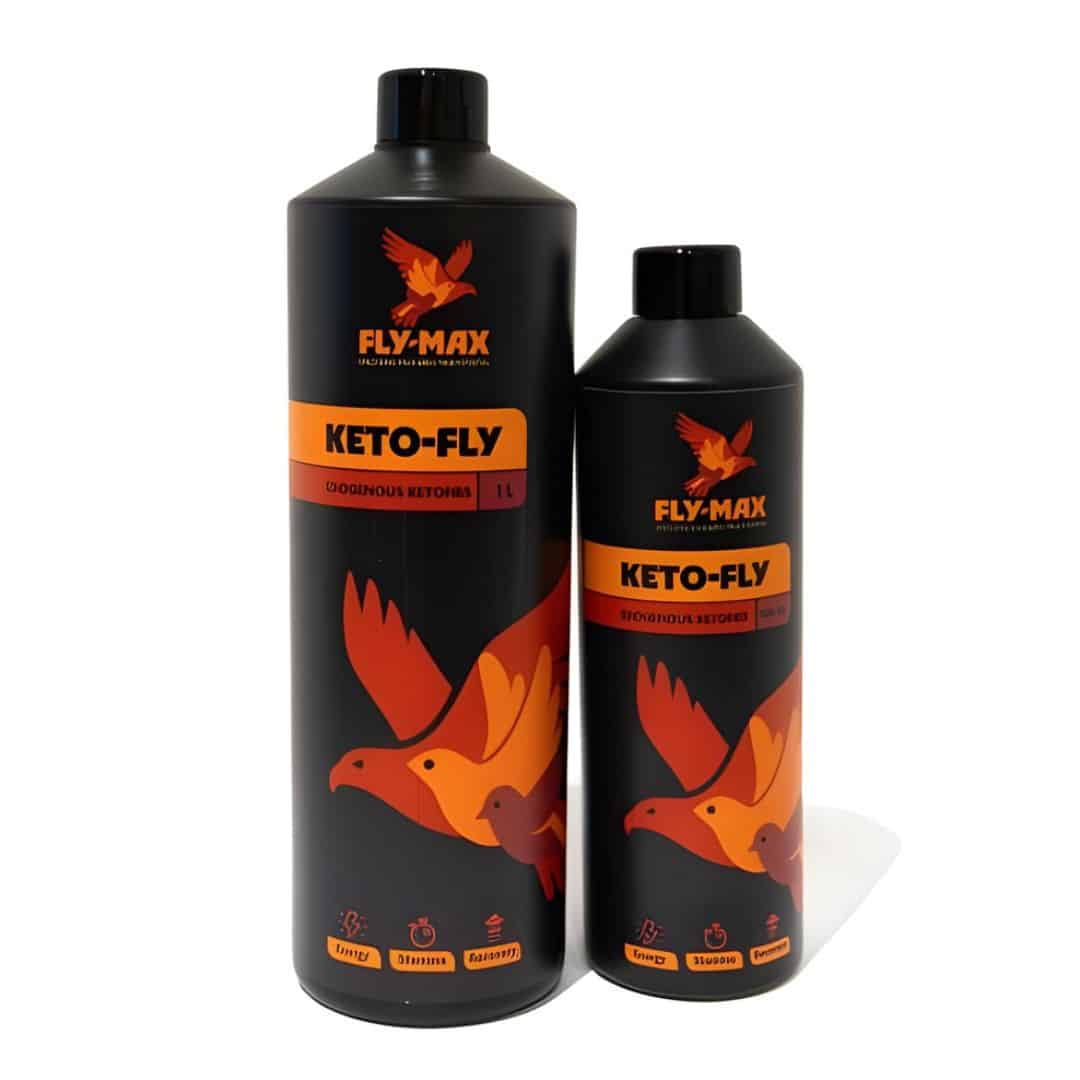 Rated 0 out of 5€ 40,00 – € 65,00Price range: € 40,00 through € 65,00Select options This product has multiple variants. The options may be chosen on the product page
Why the right form is crucial for Phase 1
Upon arrival, the pigeon already has to deal with a disrupted electrolyte balance and a lowered pH in the organism. Administering heavy salt compounds (such as ketone salts) at that specific moment forces the gastrointestinal tract into active digestion. This activates the digestive engine, whereby the priority cellular cleanup and mitochondrial biogenesis of Phase 1 are directly inhibited or even completely blocked.
Only the liquid form bypasses this intestinal strain completely. This liquid complex functions not only as a pure fuel, but as a powerful signaling molecule that structurally reprograms the biology of your pigeons. Thus, it offers a unique, dual role: it programs the metabolic memory during training work and maximizes recovery during the season.
In this article, we focus specifically on the liquid variant. It is, after all, in this liquid form (Keto-Fly) that our expertise, deep product development, and extensive scientific testing have been and will be conducted.
1. Before the season: Training work and the metabolic memory – the foundation for a successful season.
(Administration AFTER training)
Success does not happen by chance. In cycling, people don’t talk about the difference between a ‘good winter’ and a ‘bad winter’ for nothing. With this, riders refer to the quality of the training work and the conditioning in the off-season. Whoever skips the basics in the winter/before the season pays the price in the summer. That applies exactly to your pigeons: a well-thought-out, gradual training buildup is absolutely crucial to be able to shine later on.
Developed with WorldTour expertise.
For the development of Keto-Fly, we have intensively collaborated with Serge Pauwels. As a former WorldTour rider (Cervélo, Sky, Quick-Step) and current Belgian national coach, he knows better than anyone how to translate that ‘good winter’ into an indestructible baseline condition. This professional elite sports knowledge forms the blueprint behind our product.
The foundation for that ‘good winter’ is definitively laid during the early training sessions around the loft. The goal of this early training work is focused conditioning, strengthening the chest muscles, and optimally training the mitochondria, the power plants in the cell. Consistent use of Keto-Fly during these crucial periods forces the body into a structural cellular adaptation. During the early buildup phase around the loft, the goal is to strengthen the chest muscles and train the mitochondria maximally. Normally, these first, short training sessions around the loft are physiologically not demanding enough to activate deep mitochondrial supercompensation; after all, the body lacks the extreme exhaustion of a real flight.
That is where the unique biochemical action of Keto-Fly steps in. By providing Keto-Fly directly after these early training sessions, you create a physiological ‘hack’. The sudden presence of these liquid substrates in an activated muscle compartment simulates deep cellular stress. It triggers the cell to react as if a heavy effort was delivered, whereby the process of mitochondrial biogenesis (the creation of new, healthy power plants) is artificially but effectively activated.
Get the sharpest pigeon racing insights in your inbox every Friday
Stay updated with the latest news, race results, product trends, and exclusive expert tips.
Welcome to the inner circle!
You have successfully joined our subscriber list. Check your inbox this Friday.
Upgrade of the engine: Mitochondrial biogenesis
Mitochondria are the ‘power plants’ in the muscle cells where ATP (adenosine triphosphate, the universal carrier of chemical energy) is produced. Keto-Fly stimulates the production of new, healthy mitochondria through a process called biogenesis. This has several advantages:
Greater endurance: More mitochondria ensure a larger aerobic capacity and an extremely efficient fat burning. This ensures an increase in the VO²-max (maximum oxygen uptake capacity), allowing muscle cells to convert more oxygen into pure propulsion.
Lasting effect: This increased capacity (the larger ‘volume’ of the engine) remains effective all season long, even months after the initial supplementation period. This is due to the structural epigenetic programming of the muscle cell, which maintains the density of the mitochondria at a higher level long-term.
Sparing of sugars: The pigeon can therefore fly intensively for much longer without tapping into its emergency reserve of sugars (glycogen). As we already indicated in our first article about the energy cycle, this glycogen store in the muscles is physiologically limited and cannot simply be increased.
-
Rated 0 out of 5€ 40,00 – € 65,00Price range: € 40,00 through € 65,00Select options This product has multiple variants. The options may be chosen on the product page
Important guideline for young pigeons!
-
Start only after two weeks of training: Introduce Keto-Fly to young pigeons only when they have been training for at least two weeks. The substantial energy boost can namely cause them to wander too far from the loft too early. This minimizes the risk of losses in the early phase of their learning process, because their cognitive map and orientation capacity cannot yet keep up with the physiological ‘super-engine’. Provide Keto-Fly to young pigeons in this early buildup phase, just like with the old pigeons, exclusively DIRECTLY AFTER the daily home training.
2. During the season: Training work and oxygen efficiency.
(Administration BEFORE training)
From engine buildup to engine protection. Whereas the early training sessions before the season were intended to make the engine larger via Phase 1 recovery, the focus shifts during the active racing season toward protecting and optimally utilizing that engine. During the season, the pigeons must train hard during the week to maintain their sharp edge, but they must not burn up their energy reserves and muscle tissue before the actual flight.
When discussing the energy values, we must make a crucial physiological nuance. Although ketones and fats, at 9 kcal per gram, are more than twice as energy-rich as carbohydrates (4 kcal per gram), and moreover consume less oxygen in the muscle cell engine, we cannot administer them during the flight itself.
The true value of this ‘superfuel’ therefore lies not in direct feeding during a race, but in strategically directing the endurance training sessions at home:
-
Forcing longer training sessions: Endurance training is the most important foundation during the buildup of the season. By providing Keto-Fly on targeted training days, the system receives liquid precursors directly via the bloodstream without costing digestive energy. This allows the chest muscles to work longer at high efficiency during intensive home flights without entering acute anaerobic acidification. This prevents the body from having to tap into its own muscle proteins for energy, allowing you to deliver qualitatively heavier training work without tiring the colony too deeply.
Programming the ‘Metabolic Switch’
As we have extensively explained in our first article about the 2-phase recovery protocol, the great danger with longer flights lies in the tipping point where sugars run out and the cell must abruptly switch to fat burning. At that moment, the engine sputters briefly, which leads to performance loss and a sharp peak in oxidative stress. Consistent and intermittent use of Keto-Fly trains the metabolism beforehand to make this switch proceed seamlessly.
By administering Keto-Fly beforehand, the oxygen-efficient ketones are already circulating in the bloodstream the moment the pigeons take off. The chest muscles consequently work directly at a higher aerobic efficiency.
The biochemical explanation for this is that Keto-Fly activates specific transport proteins (such as CPT-1) and enzymes that are responsible for the transport of fatty acids through the mitochondrial membrane. The pigeon thereby ‘remembers’ how it can switch faster between different energy sources. This prevents the notorious ‘unclean combustion’ and subsequent muscle damage by free radicals that we described in the previous article when the sugars are 100% depleted.
Because directly usable energy is present in the bloodstream, the body does not have to break down its own valuable muscle proteins to obtain fuel. You can deliver qualitatively heavier training work, without physiologically exhausting the colony before the weekend.
What happens upon administration before caging (inkorving)?
Although the focus is primarily on training and recovery, there is a valid theoretical basis why administration right before caging offers an indirect advantage, despite the hours or days the pigeons spend in the basket:
-
Sugar sparing through stress reduction: The basket period causes stress, which leads to an unwanted, subclinical burning of the primary sugars (glycogen).
-
Alternative ‘basket-fuel’: By providing Keto-Fly right before caging, a directly usable substrate circulates in the bloodstream. The organism can use these ketones for basal processes during the hours of rest in the basket.
-
Protection of the battery: The precious glycogen store in the muscles remains optimally spared because of this. The pigeon thus starts the final race with a fuller energy reserve.
Note from DoCa-Pharma: Because the basket duration varies greatly in practice and we have not yet extensively clinically tested this specific application, we advise to continue placing the emphasis on the proven effects around weekly home training sessions and direct recovery, and not to rely solely on the potential gains from administering before caging.
3. During the season: The role in Phase 1 of the recovery.
(Administration AFTER arrival)
Protecting the priority phase. Directly after the flight, we arrive at the foundation of our 2-Phase Recovery Protocol. As we have extensively explained in our first article about the metabolic blockade, Phase 1 must absolutely not contain heavy amino acids or sugars. These namely force the intestinal wall into active digestion and instantly shut down the cellular cleanup. Keto-Fly is the ultimate ally in this priority phase to physiologically maximize recovery.
-
Direct absorption without digestive energy: Due to the unique liquid form, the ketone precursors are absorbed directly into the bloodstream via passive absorption. This does not strain the exhausted digestive system of the pigeon, allowing all remaining energy to go to physiological recovery.
-
Biochemical synergy with hydration: The simultaneous administration of Keto-Fly with fluids and electrolytes is crucial. The formed ketones are transported into the muscle cell via specific Monocarboxylate Transporters (MCT-1). This active transport process is physiologically highly dependent on a correct sodium and fluid balance.
Note: this stands in sharp contrast to the previously discussed ketone salts. Where the heavy, chemically bound minerals in ketone powders demand active digestive work from an exhausted intestinal wall, loose, well-balanced electrolytes in the drinking water are directly absorbable, free ions. The electrolytes guarantee not only an efficient absorption through the intestinal wall, but also keep the blood pH stable to buffer the metabolic acidosis (acidification) after the flight.
-
Accelerating cellular cleanup (Autophagy): During a heavy flight, cell components inevitably become damaged. Autophagy is the evolutionary process whereby the cell breaks down and recycles these damaged parts into new, clean building blocks. Keto-Fly activates and accelerates this cleaning process, running cell repair at full speed almost immediately after the flight.
-
Damping of oxidative stress: As described in our previous article, the pigeon often lands with exhausted sugars, after which an unclean fat burning causes an explosion of free radicals and microtraumas. Keto-Fly supports the endogenous antioxidant systems of the bird. This significantly shortens the acute inflammatory phase after a heavy flight and minimizes muscle damage in the long term.
-
The perfect trailblazer for Phase 2: Ketones have the physiological property that they temporarily strongly increase the insulin sensitivity of the muscle cells. This solves the major physiological paradox we wrote about in our first article: misleading the traditional ‘0 to 6 hour recovery window’. Anyone who gives sugars directly after the flight blocks the vital Phase 1. By deploying liquid ketones, we reprogram the cell, whereby this golden absorption window is artificially extended and shifted to the start of Phase 2. This maximizes the efficiency of sugar and protein uptake in Phase 2. This leads to up to 50% higher glycogen supercompensation in the chest muscles compared to traditional recovery methods. The energy tank is thus filled not only faster, but also fuller for the next flight.
4. A look at the future: concrete schedules
With the liquid ketones of Keto-Fly, you bring a scientifically backed revolution into your loft. Whether it concerns structurally enlarging the engine during early training work, protecting energy reserves during the week, or maximizing cellular cleanup directly upon arrival: the physiological benefits are undeniable.
The theory behind this molecular revolution is now clear, but how do you translate this concretely into daily practice in your own loft? In our next article, we will finalize the details. There, you will receive our exact, ready-to-use administration schedules for the entire year, so you can perfectly tailor Keto-Fly to every phase of the season.
Do you already have specific questions about the operation or application of this protocol? Do not hesitate to pass your questions on to the Pigeon Boss or at DoCa-Pharma, so we can support you optimally right away.
Wishing you a successful remainder of the season!